Attempted AI

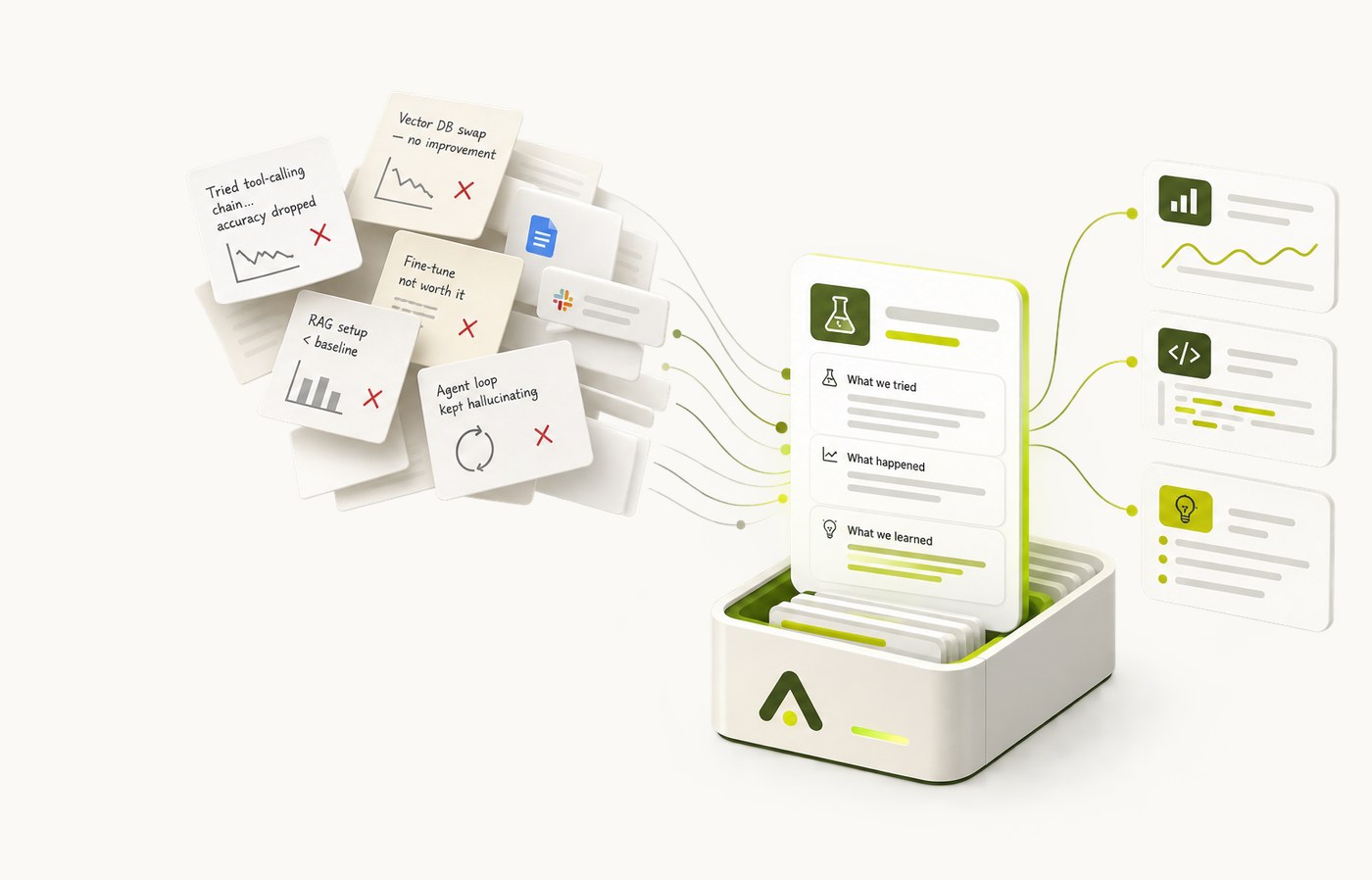
What AI builders tried. What happened. What they learned.

Every AI team experiments. Most of what doesn't work disappears inside Slack threads, internal docs, abandoned prototypes, and people's memories. The next team starts from zero and finds the same wall.

Attempted AI makes those lessons reusable.

What an attempt looks like

Structured enough to learn from. Short enough to write.

An attempt isn't a postmortem or a blog post. It's six fields — the shape that makes one team's experience usable by another. Successful, partly successful, and failed attempts all count.

  1. Goal
  2. What was tried
  3. What happened
  4. Why
  5. What changed
  6. Lesson

Illustrative only. These four are written to show the format — they are not real submissions and are not attributed to any team. Real contributed attempts will always carry their source.

RAG

Chunk size tuning stopped mattering once retrieval was the bottleneck

Goal
Improve answer quality on a 40k-document internal knowledge base.
What was tried
Six weeks of chunking experiments — sizes from 256 to 2048 tokens, overlap sweeps, semantic vs. fixed splitting.
What happened
Every configuration landed within a few points of the others. Quality stayed flat.
Why
The retriever was returning plausible-but-wrong passages regardless of how they were cut. Chunking was never the constraint.
What changed
Measured retrieval recall separately from answer quality, then added a reranker. Recall was the actual gap.
Lesson: measure each stage of the pipeline before tuning any single one. A flat sweep means you're tuning the wrong stage.

Three more, same format

Agent Giving the agent more tools made it measurably worse Tool count is a cost, not a feature.
Goal
Extend a support agent to resolve more ticket types without human handoff.
What was tried
Grew the toolset from 5 to 23 tools over two months, each one individually justified.
What happened
Task completion dropped. The agent picked wrong tools, chained unnecessary calls, and occasionally looped.
Why
Several tools had overlapping descriptions. Selection became ambiguous, and nothing in the loop penalised a wrong-but-plausible choice.
What changed
Cut to 9 tools with disjoint descriptions and routed the rest behind a single dispatch tool.
Lesson: tool count is a cost, not a feature. Test selection accuracy as its own metric before adding to the surface.
Model Fine-tuning worked, and still wasn't worth keeping Cost the maintenance, not just the training run.
Goal
Improve classification accuracy on a domain-specific labelling task.
What was tried
Fine-tuned a smaller model on ~8,000 hand-labelled examples.
What happened
Accuracy beat the prompted baseline. The model was retired four months later anyway.
Why
The label distribution shifted with the product, so the tune needed re-running. Nobody owned that, and the cost of the pipeline outweighed the accuracy gain.
What changed
Moved back to a prompted approach with a small evaluated example set that anyone on the team could edit.
Lesson: cost the maintenance, not just the training run. A fine-tune you can't afford to repeat is a slowly expiring asset.
Data A knowledge graph added real structure and no measurable answer quality Check what fraction of live traffic a technique actually addresses.
Goal
Answer multi-hop questions that flat vector retrieval kept missing.
What was tried
Built an entity-and-relation graph over the corpus and routed retrieval through graph traversal.
What happened
Multi-hop questions improved. Overall quality didn't move, and p95 latency roughly tripled.
Why
Genuine multi-hop questions were about 4% of real traffic. The graph optimised a rare case and taxed every other query.
What changed
Kept flat retrieval as the default and routed only detected multi-hop questions to the graph path.
Lesson: check what fraction of live traffic a technique addresses before it becomes the default path.

Early access

Attempted AI is being built in the open.

It's an early concept. If the idea is useful to you, leave your details — you'll get access first, and a say in how contributions are structured and protected.

Your email is used to contact you about Attempted AI and nothing else. No list sales, no newsletter you didn't ask for. Contributions will always let you choose attribution, anonymity, or redaction — that decision stays yours.